Social Media Shapes Decisions Even When It Does Not Convert
Social media doesn’t have to generate leads to influence outcomes.
In senior and home health care marketing, social media rarely functions as a primary discovery channel. Families typically begin their search with Google or provider websites. But that doesn’t diminish social’s importance—it defines it.
Our research shows that 73% of caregivers say social media has at least some influence on their provider choice. Social is where families validate what they find elsewhere. It’s where they look for signals of credibility, authenticity, and consistency before deciding whether a brand feels trustworthy.
For agencies, this reframes what social success actually looks like.
Caregivers use social media to answer unspoken questions. Are real people behind the brand? Does the organization communicate clearly? Are staff visible? Do stories feel authentic or polished? Social content doesn’t need to close the deal—it needs to make the decision feel safer.
When social feeds are inactive, overly promotional, or disconnected from the website experience, families fill in the gaps themselves. Often, that means assuming the organization is disengaged, outdated, or difficult to work with.
The most effective agencies treat social media as trust infrastructure rather than a conversion channel. Content priorities shift accordingly: staff spotlights, educational clips, day in the life visuals, and real family stories outperform traditional promotional posts. The goal is familiarity, not persuasion.
This matters even more as younger caregivers—Millennials and Gen Z—become more involved in senior care decisions. These groups expect brands to show up consistently across platforms and interpret silence as a warning sign.
Importantly, social media does not replace search or websites. It reinforces them. When agencies help clients align messaging across channels, social becomes a stabilizing force in the decision journey—reducing uncertainty and increasing confidence long before outreach.
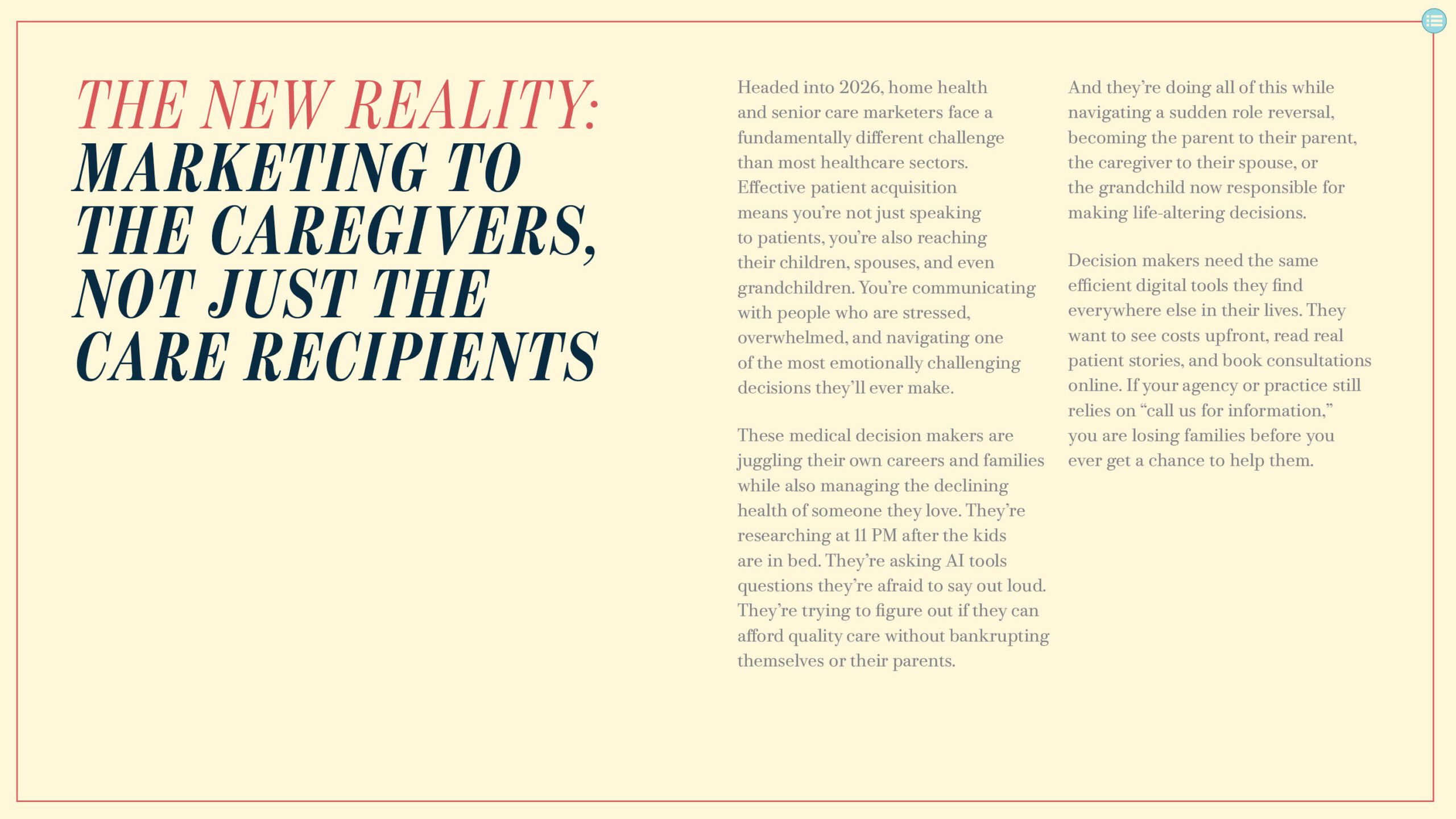
The 2026 Senior & Home Health Care Marketing Outlook explains how social media influences caregiver behavior across generations, why it plays such a powerful supporting role, and how agencies can adjust expectations, content strategy, and measurement accordingly.
If social media performance feels ambiguous or undervalued, the issue may not be the channel—it may be how success is being defined.
Download the full report to understand social media’s true role in senior and home health care decisions in 2026.





 Ad Choices